ALL ABOUT KARTHIGAI DEEPAM
- S Subramaniam
- Dec 5, 2025
- 6 min read
A sincere attempt has been made by yours truly to collect, summarise and share all significant, relevant information about one of the prime festivals of Tamil Nadu. I have indexed them here:
Index
1.Karthigai deepam in ancient Tamil Literature
2.Kanchi Paramacharya's explanation
3.The Shivite school
4.The Vaishnavite school
5.Legend associated with Lord Muruga
6.Karthigai deepam in Sri Lanka
7.Yanai pandigai
8.Karthigai in Kerala
8.Karthigai chutru
10.Kuppai Karthigai
11.he special offerings
Conclusion / Author's views
1.Karthigai deepam in ancient Tamil Literature:
The festival seems to be as ancient as the language itself. The Sangam period makes a specific mention about the Karthigai deepam festival and during those days it was known by the name Peru-vizha or the big festival. Kaar Naarpathu, a collection of 40 poems (narpathu) on Kaar (rain / cloud) composed by the famous Tamil poet Kannan Koothanar (circa 500 BC) contains the following verse:
(This is just a sample. There are plenty of other verses in Sangam Literature)
நலமிகு கார்த்திகை நாட்டவ ரிட்ட
தலைநாள் விளக்கிற் றகையுடைய வாகிப்
புலமெலாம் பூத்தன தோன்றி
சிலமொழி தூதொடு வந்த மழை.
Meaning: Similar to the earthen lamps that are lit and arranged in rows during Karthigai, the flowers too bloom in rows and the rain brings the message [of the arrival of the Thalaivan (lover boy) to the longing Thalaivi (lover girl) ]
2.Kanchi Jagadguru on KARTHIGAI DEEPAM
Kanchi Paramacharya, Jagadguru Sri Chandra Sekhara Saraswathi Swamigal (Mahaperiyava) had once offered an excellent explanation about the importance of the festival and the same is quoted below:
The idea of lighting the deepam with such consecration is that every person who sees the light and every living creature, be it a worm, an insect, a bird, a beast or a plant, on which the luster of the deepam falls, will be suffused with the presence of God and will be blessed by Him. The following prayer is accordingly recited when lighting the Karthigai Deepam.
कीटा: पतङ्गा: मशका: च वृक्षाः
जले स्थले ये निवसन्ति जीवाः|
दृष्ट्वा प्रदीपं न च जन्म भाजा:
सुखिनः भवन्तु श्वपचाः हि विप्रा:||
கீடா பதங்கா மசகாச்ச வ்ருக்ஷா ஜலே ஸ்தலே யே நிவஸந்தி ஜீவா த்ருஷ்ட்வா ப்ரதீபம் ந ச ஜன்ம பாஜா
ஸுகின பவந்து ச்வபசா ஹி விப்ரா
The Sloka was composed by Paramacharya himself
Interpretation
Be it a worm, or any kind of bird or insects such as mosquito etc., be it trees or any member of the plant Kingdom, be it any living organisms residing in water, or be it the Veda chanting Brahmin (Vipra) or dog-meat eating Chandala (Swapacha - svanam in Sanskrit means dog), whoever happens to see the lamp lit on Karthigai Deepam day, may all their sins be washed off and may they be granted relief from the cycle of birth, death and rebirth.
Keedah (insects) pathangah (birds) masakascha (beasts) vrikshah (plants/trees) Jale sthale ye nivasanti jeevah:
Drstva pradeepam nacha janmabhagina:
Bhavanti nityam svapachahi vipraa:
3.The Shivite school
Lord Shiva's devotees consider the Karthigai deepam day very auspicious as it was on this day Lord Shiva revealed his endless form, as fire, before Brahma and Vishnu.
Lord Shiva is worshipped in the five forms of nature such as air, water, fire, earth and space. There are five temples dedicated for this which are located at Sri Kalahasti (AP), Thiruvanaikovil (TN), Thiruvannamalai (TN), Kanchipuram (TN) and Chidambaram (TN) in that order.
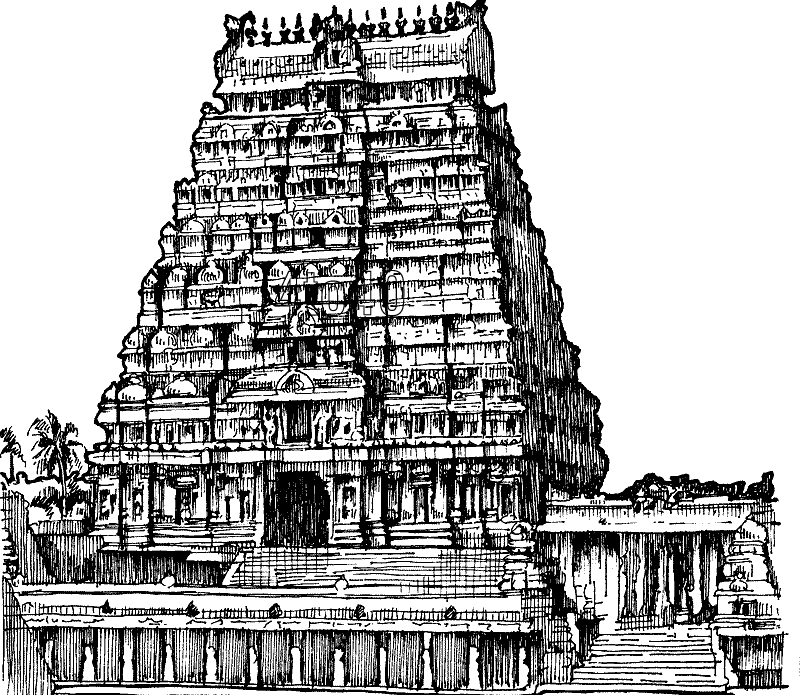
At Thiru Annamalai the Lord appears in fire form and Karthigai deepam is associated with and celebrated in a grand manner there.
It is a custom to light the Maha Deepam on the day of the festival at the top of 2668 ft high holy mountain. Maha Deepam is lit using nearly 3500 kg of Ghee and the light will be visible around the Holy Mountain within a radius of 35 km.
Lakhs of devotees perform 16 km Girivalam (circumambulation / pradakshinam of the holy mountain). The Moist Black Ash (they call it 'Mai' in Tamil) that remains is collected at the end of the festival, preserved and distributed as Prasadam to devotees on Arudra Darshan day which usually falls on the next full moon day, exactly a month later.
4.The Vaishnavite school
Vaishnava devotees celebrate Karthigai deepam as Vishnu deepam. It is believed that it was on this day king Mahabali was pressed into the Nether World (patala loka) by Lord Vishna in his incarnation as Vamana.
5.Legend associated with Lord Muruga
It is believed that Lord Shiva created son Muruga from his 3rd eye of six primary faces - Tatpurusam, Aghoram, Sathyojatam, Vamadevam, Eesanam, Adhomukam. It is believed that the six forms were made into six children and each of them brought up by the six Karthigai nymphs named Dula, Nitatni, Abhrayanti, Varshayanti, Meghayanti and Chipunika who later got merged into one by his mother Parvati. Hence we celebrate Karthigai deepam to pay respects to the six nymphs.
6.Karthigai deepam in Sri Lanka
As in Tamil Nadu, Karthigai festival is also famous in Koneshwaram, Trincomalee, Sri Lanka. The festival is celebrated for three days. The first day is called Appa Karthigai (dedicated to Lord Shiva) the second day Vadai Karthigai (dedicated to Lord Murugan) and the final day is called Thiru Karthigai, when the main pooja is performed.
On Karthigai day, a huge fire lamp is lit up on the hill which is visible for several kilometers around. The fire (deepam) is called Mahadeepam. Hindu devotees visit the place, to pray and make offerings to Lord Shiva.
7.Yanai pandigai
Yanai Pandigai (festival of the elephants) popular among Mandyam Ayyangar community is celebrated on the Karthigai deepam day. The festival is dedicated to elephants. Tiny elephants are made of clay and are decorated with clothes and ornaments. Women and girls go around them sprinkling coconut water and milk on them. Decorative lamps (deepam) are lit around the clay elephant.
Real size elephants are fed with sugarcane, jaggery and fruits, especially banana.
8.Karthigai Deepam in Kerala
In Kerala, the festival is known as Thrikkarthika, celebrated to welcome Goddess Karthiyayeni (Chottanikkara Amma) Bhagavathi. The customs are more or less similar to the Tamil culture.
9.Karthigai Sutru or Maavali
Karthigai Sutru / Karthigai chutru or or maa-ali is an important item associated with a festival. It is a raw, homemade charcoal-based hand-rotating firecracker displayed during Karthigai deepam in rural Tamil Nadu_.
Origin of Karthigai Sutru is not exactly known, but it is generally believed that Tirunelveli region of ancient Pandiya Nadu is the place the fire cracker must have made its first appearance sometime during the Before Christ era.
This cracker is made of crushed and packed charcoal mixed with dried palm flowers put into coconut shell. The packing is tightly placed inside 3 twigs or flexible wood stick or plant stem. The twigs are tied with ropes with a safety distance. Few burning charcoal is placed over the packing and blown hard or rotated until The packing gets slowly ignited. While the packing started ignited then it can be rotated faster with help of the rope. The falling pieces of burning charcoal pieces from the packing gives a fire cracker effect. The charcoal mixture is sometimes mixed with dried palm flower pieces for more sparkling effects.
Sadly this age old practice has gone into oblivion now similar to bursting of crackers during Diwali now. But still, in some remote villages in TN, the practice of Karthigai Sutru is observed even today.
10.Kuppai Karthigai
Ages before our Honl. Prime Minister Sri Narendra Modi introduced the concept of Swachh Bharat, Tamilian dedicated a day, an exclusive festival for swachh or cleanliness. Kuppai Karthigai ( or trash Karthigai) is the name of the festival and is usually celebrated on the last day of the festival. Lamps are lit near dustbin, or where waste and refuse are thrown and at the doorstep of wash-rooms.
11. Special offerings such as adai and pori urundai (sweet made of puffed rice) are offered to god during Karthigai festival. There is no mention about it any religious text and it can be safely inferred as just a custom, practice or a tradition that has been passed on to us by generations after generations.
12. That brings us to the concluding part. To me the earthen lamp / diya / agal vilakku / maatir prodeep is very appealing. It is a great teacher and teaches us two basic, fundamental lessons in life;
1.Never confine the knowledge or wisdom to your own self. Share it, spread it, like the diya spreading light.
2.Shun your pride, always be simple, humble and modest.
To quote Tagore,
“Who is there to take up my duties?” asked the setting sun. The world remained dark and silent. With joined palms said the earthern lamp, “I will do what I can, my master!”
Wishing all the readers a blissful, joyous and happy Karthigai greetings…